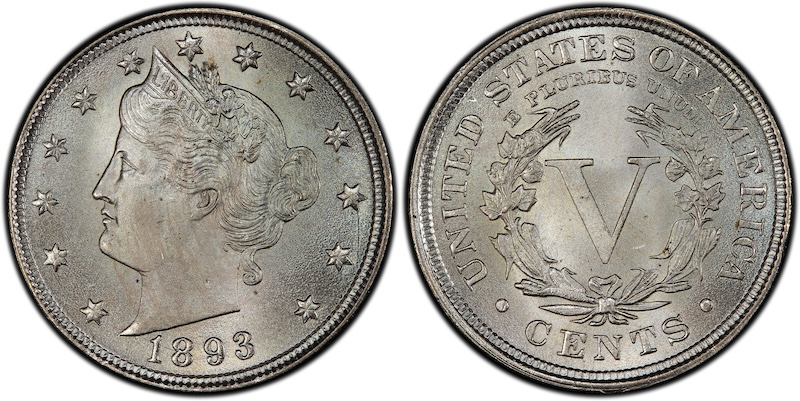
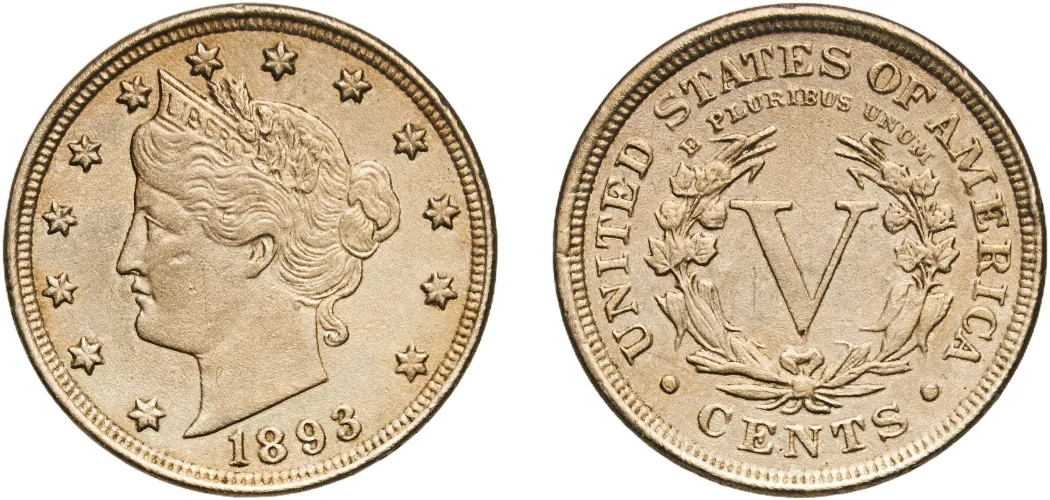
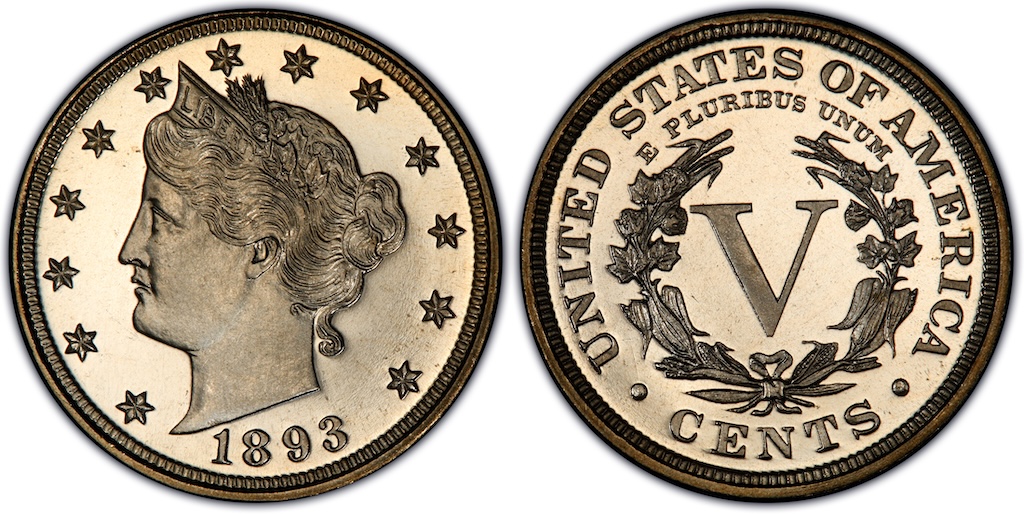
A gem-grade 1893 Liberty Nickel sold for $22,325 at Stack's Bowers — yet heavily worn examples still circulate for under $15. Everything hinges on strike quality, condition, and whether you're holding a business strike or one of just 2,195 proofs. This free guide cuts through the confusion.
★★★★★ Trusted by 14,600+ collectors · Based on PCGS & Heritage auction data
Check My 1893 Nickel Value →Before diving into the calculator, this quick-reference table shows what each variety and condition tier typically brings at auction. Rows highlighted in gold represent the Proof series — the signature category for the 1893 issue. For a fully illustrated step-by-step 1893 Liberty Nickel identification guide, cross-reference these values against certified population data before buying or selling.
| Variety | Worn (G–VG) | Circulated (F–EF) | Uncirculated (MS60–63) | Gem (MS64–67) |
|---|---|---|---|---|
| Business Strike (Regular) | $7 – $15 | $24 – $75 | $160 – $230 | $385 – $22,325 |
| Broadstrike Error | $40 – $80 | $100 – $200 | $250 – $450 | $600 – $1,200+ |
| Clipped Planchet Error | $35 – $70 | $80 – $175 | $200 – $400 | $500 – $1,000+ |
| 🥇 Proof Strike (PR) | — | $185 – $215 | $230 – $375 | $525 – $5,250+ |
| 🔴 Proof Deep Cameo (DCAM) | — | — | $800 – $2,000 | $2,500 – $5,250+ |
🥇 Gold row = Proof series (signature variety). 🔴 Red row = Proof Deep Cameo (rarest). Values based on PCGS Price Guide & recent auction results. Individual coins vary — get certification before selling high-grade examples.
🪙 CoinKnow lets you snap a photo of your 1893 nickel and get an instant on-the-go value estimate — a coin identifier and value app.
Jump to any section for fast answers about your 1893 Liberty Nickel.
The 1893 Liberty Nickel series is known primarily for planchet and die-strike errors rather than hub-doubled varieties. Each error below represents a genuine deviation from the standard minting process and carries a measurable premium over a normal business strike. The cards below cover the most documented and collectible error types, ordered roughly by collector demand.
A broadstrike error occurs when a 1893 Liberty Nickel planchet is struck outside the retaining collar die. Without the collar to constrain the metal, the coin expands outward beyond its normal 21.2 mm diameter, producing a pancake-flat, oversized disc with a characteristic rounded, featureless edge.
Visually, the design spreads toward the rim and the lettering crowds outward. Liberty's portrait flattens slightly, the reverse wreath splays, and the edge lacks the plain, well-defined border of a normal strike. Diameter can increase by 1–3 mm depending on the severity of the misalignment.
Collectors prize broadstrikes for their dramatic, unmistakable appearance. Higher-grade broadstrikes — showing no circulation wear alongside the error — are especially sought after, as the combination of full design detail and the expanded planchet makes for a visually compelling numismatic curiosity.
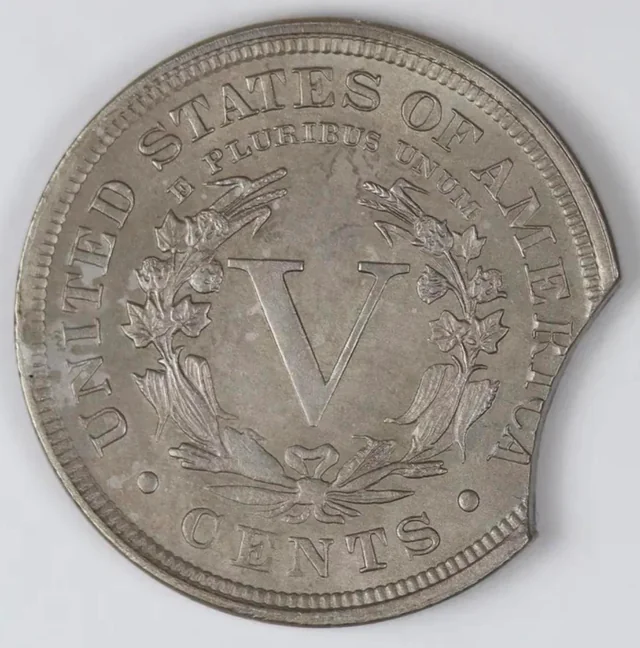
A clipped planchet error results from the blank-punching process at the Philadelphia Mint. When a steel rod overlaps a previously punched area of the metal strip, the resulting blank is missing a portion of metal at its edge. The clip is typically curved (conforming to the punch shape) or, less commonly, straight.
On a 1893 Liberty Nickel, a curved clip appears as a smooth, concave bite taken from the rim. The Blakesley effect — a corresponding weakness in the lettering or design at the point exactly opposite the clip — is the key diagnostic that confirms the error is genuine and not a damaged coin.
Clipped planchet examples are among the most visually striking mint errors available in the Liberty Nickel series. Large clips (removing 15–20% of the planchet mass) are rarer and command stronger premiums than small clips, particularly in Uncirculated condition.
Lamination errors on the 1893 Liberty Nickel arise from impurities or voids trapped within the copper-nickel alloy strip during the rolling process. As the strip is reduced to coining thickness, foreign substances or gas pockets create internal fractures that may detach from the coin's surface, leaving a depression or raised flap of metal.
On the coin's surface, a lamination appears as a flaking or peeling layer of metal — either still partially attached (raised flap) or fully separated, leaving a void. Laminations on the obverse field or portrait are most desirable to collectors, particularly if they are large and dramatic. Size, location, and whether the flap remains attached all influence value.
Unlike a clipped planchet, lamination errors occur at the alloy-preparation stage, not the blanking stage. This makes them a distinct and separately catalogued error type. Large, dramatic laminations on high-grade 1893 Liberty Nickels are genuinely scarce and attract collector premiums that rival larger-format planchet errors.
A brockage error is one of the most dramatic and rare mint errors possible on an 1893 Liberty Nickel. It occurs when a previously struck coin becomes stuck to one of the dies, face-down, and acts as an impromptu die for the next blank. The result is a coin struck with one normal side and one side bearing a mirror-image, incuse (sunken) impression of the design.
A full brockage on an 1893 Liberty Nickel shows a perfectly reversed, incuse Liberty portrait on one face and the normal reverse — or vice versa. Partial brockages, where only a portion of the coin was contacted by the stray coin-die, are more common but still extremely valuable. The incuse detail should be sharp and well-defined, not smeared.
Brockages are among the most prized error types across all American coinage because they directly demonstrate the mechanics of the coining press. On a 130-year-old series like the Liberty Nickel, a confirmed brockage commands a dramatic premium, and competition among advanced error collectors is fierce.
Think you've spotted one of these errors on your coin? The calculator below will give you an instant value estimate.
Calculate My Coin's Value →
The Philadelphia Mint — sole producer of 1893 Liberty Nickels
| Type | Mint | Mintage | MS Certified (PCGS/NGC/ANACS) | Notes |
|---|---|---|---|---|
| Business Strike | Philadelphia (P) | 13,368,000 | ~1,427 | No mint mark; rank 14 of 33 dates by mintage |
| Proof Strike | Philadelphia (P) | 2,195 | ~954 (PR + PRCA + PRDC) | Scarcer proof year; Cameo: 264 certified; DCAM: only 18 certified |
| TOTAL | — | ~13,370,195 | — | Philadelphia only — no branch mint nickels in 1893 |
Despite a business-strike mintage of over 13 million, surviving high-grade examples are scarcer than the numbers suggest. Heavy circulation during the Panic of 1893 economic downturn wore many specimens to low grades. PCGS notes that fully struck examples — with all stars sharp and the lower-left corn ear complete — are difficult to locate even among certified MS coins.
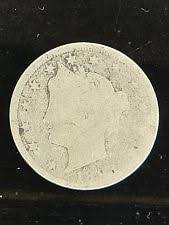
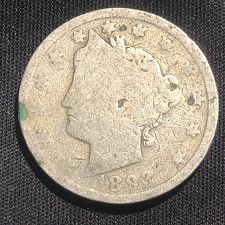
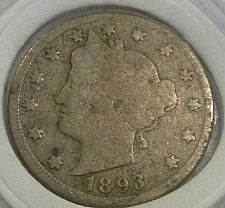
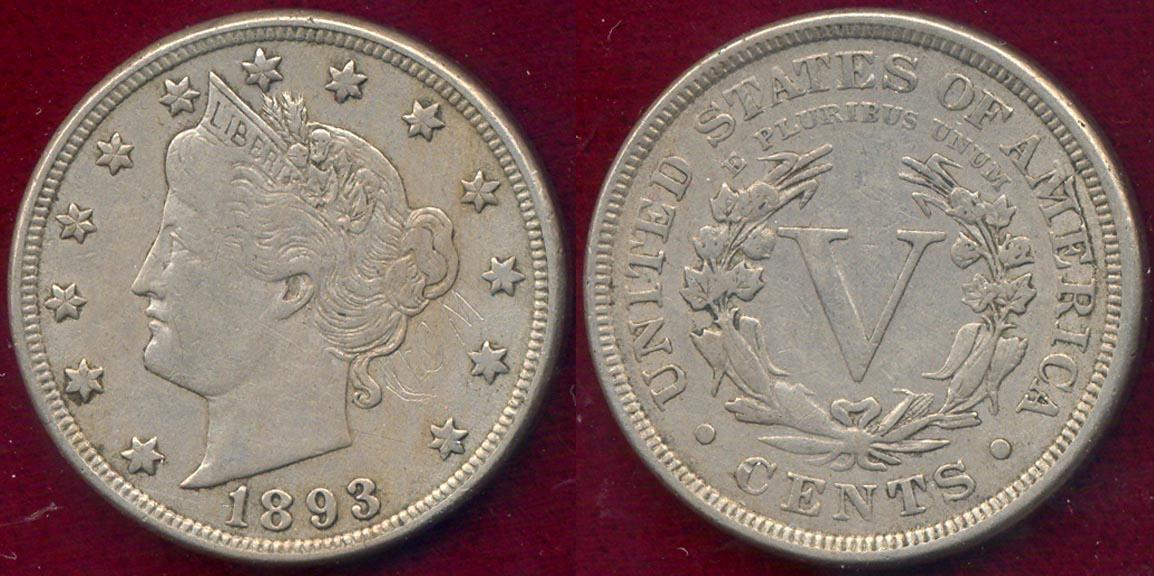
Left to right: Good · Fine · Extremely Fine · Mint State — four condition tiers at a glance
Heavy flatness across Liberty's portrait. The headband motto LIBERTY is partially worn away — only 3–4 letters visible in VG. Wreath on reverse shows as an outline. Value: $7 – $15.
All seven LIBERTY letters visible in Fine; sharp in EF. Hair strands above Liberty's ear visible in EF. Reverse corn ear and wreath details show clearly at EF. Value: $24 – $75.
No wear on high points — Liberty's cheek and hair above the ear show original texture. Luster may be slightly broken in AU. MS60–63 coins show full luster but may have bag marks. Value: $160 – $230.
Full luster, minimal bag marks, sharp strike throughout. MS65+ specimens must show the full corn ear on the lower-left reverse AND all stars fully struck. MS67 is the finest collectible grade; only a handful exist. Value: $385 – $22,325.
📱 CoinKnow helps you match your coin's surface details against graded reference examples for faster condition assessment — a coin identifier and value app.
The 1893 Proof Deep Cameo (DCAM) is the rarest and most dramatic variety. Only 18 examples have been certified across PCGS, NGC, and ANACS. Use this 4-point checklist to determine if your coin warrants professional attribution.
Left: Standard Business Strike (satiny surfaces) · Right: Proof Deep Cameo (mirror fields + frosted devices)
Satiny or frosty surfaces throughout. Fields and devices share similar reflective quality. Edge is plain but not mirror-sharp. No dramatic contrast between fields and portrait. These are the 13,368,000 circulating coins — valuable in high MS grades but not Proof-quality.
Mirror-like, highly reflective fields with a strong, visible reflection of your face or light source. Frosted, white devices (Liberty's portrait and lettering) with dramatic cameo contrast against the mirror fields. Pristine surfaces with no rub whatsoever. Just 18 certified examples across all grading services — a genuine numismatic trophy.
The calculator below estimates value for both business strikes and proof varieties. Select your condition and any errors to get an instant range.
Use the Value Calculator →Select your coin's type, condition, and any errors — then hit Calculate for an instant value estimate backed by PCGS and Heritage auction data.
If you're not yet sure about your coin's mint type or condition, there's a free 1893 Nickel Coin Value Checker tool that lets you upload a photo and receive an AI-powered identification before coming back here to run the numbers.
Not sure which buttons to click? Describe your coin in plain English below and our keyword analyzer will identify what you may be holding.
The right venue depends on your coin's grade and variety. Use these four channels to maximize your return.
The premier choice for high-grade or Proof examples — particularly MS65+, any Proof, or Cameo/DCAM varieties. Heritage and Stack's Bowers reach the deepest pool of advanced Liberty Nickel collectors. Both firms have strong track records with the 1893 date, including the $22,325 MS67 sale. Submit at least 4–6 weeks before the next major sale. Expect 15–20% buyer's premium on the hammer price.
Excellent for circulated examples in Good through Extremely Fine condition, and for error coins like broadstrikes and clips. Completed recently sold 1893 Liberty Nickel prices on eBay give you a real-time comp before listing. Use auction format for rarer pieces, Buy-It-Now for common grades. Always photograph clearly and describe accurately — Liberty Nickel buyers are knowledgeable.
Fastest option for quick cash, but expect 60–70% of retail value — dealers must build in their margin. Best for worn circulated examples (G through VF) where auction and eBay fees may erode profits. A reputable LCS can also advise whether your coin is worth grading before selling. Call ahead and ask if they specialize in early 20th-century US type coins.
The /r/Coins4Sale and /r/CoinSales subreddits plus the Collectors Universe forums attract knowledgeable buyers willing to pay fair prices. This route works well for mid-range grades (VF–AU) where Heritage is overkill but eBay fees hurt. Post high-resolution images (front, back, edge) and state clearly whether the coin is raw or slabbed. No fees beyond PayPal or similar payment processing.
Our free calculator uses real PCGS auction data to give you an instant estimate — no signup, no fees.
Calculate My Coin's Value →